
Background
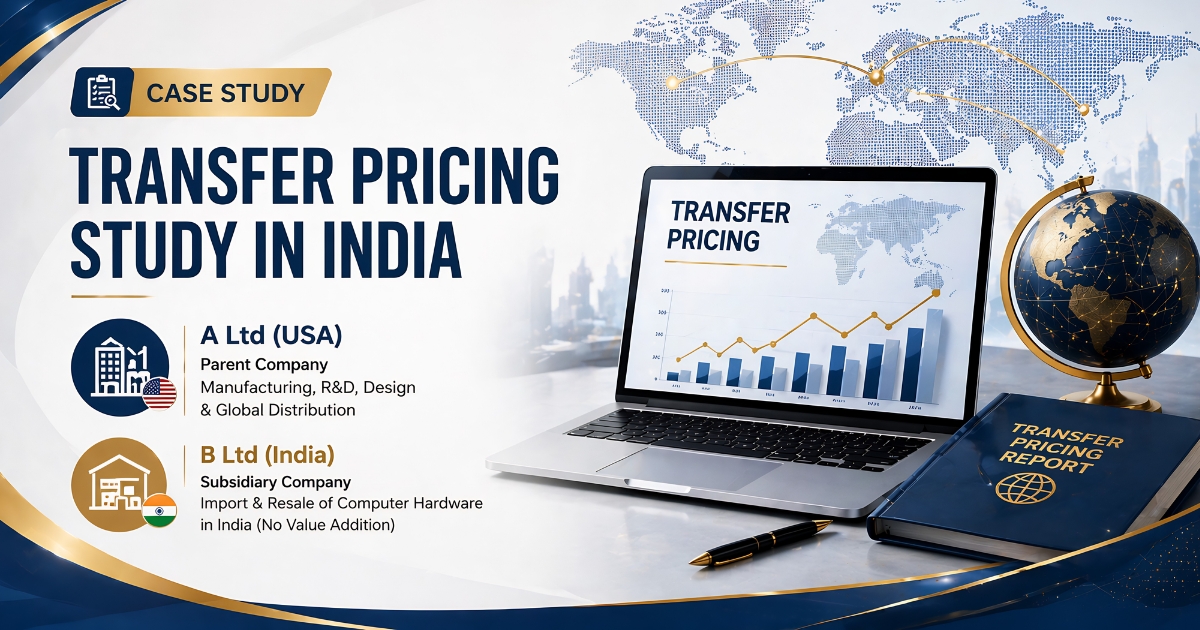
Recently, B Ltd, an Indian subsidiary of a US-based multinational group, approached us for assistance in preparing its Transfer Pricing Study Report.
The primary objective was to evaluate whether the international transactions undertaken with its Associated Enterprise (AE) were conducted at Arm's Length Price (ALP) and complied with the transfer pricing provisions of the Income-tax Act, 1961.
The management also wanted a clear understanding of:
• The structure and contents of a Transfer Pricing Study Report.
• The process of conducting a Functional, Asset, and Risk (FAR) analysis.
• The methodology used for determining Arm's Length Price.
• The selection of the Most Appropriate Method (MAM).
• The benchmarking process and final conclusions.
Group Structure
A Ltd (USA)
A Ltd is the parent company incorporated in the United States and is engaged in:
• Manufacturing of computer hardware
• Research & Development
• Product design and innovation
• Global distribution of hardware products
B Ltd (India)
B Ltd is the Indian subsidiary responsible for importing computer hardware products from A Ltd and distributing them within the Indian market.
The company does not undertake any manufacturing or value-addition activities. Its primary role is limited to warehousing, distribution, and sales support within India.
Given these transactions with its Associated Enterprise, B Ltd was required to evaluate whether the pricing of imports was consistent with the arm's length principle.
Structure of the Transfer Pricing Study
A comprehensive Transfer Pricing Study generally consists of the following sections:
- Executive Summary
- Group Overview
- Industry Analysis
- Functional Analysis (FAR Analysis)
- Selection of Tested Party
- Selection of the Most Appropriate Method (MAM)
- Economic Analysis & Benchmarking
- Conclusion
- Appendices
Executive Summary
The Executive Summary provides a high-level overview of the transfer pricing study and summarizes the outcome of the benchmarking analysis performed for determining the Arm's Length Price of the international transactions.
It enables management, auditors, and tax authorities to quickly understand the conclusions of the study.
Group Overview
This section provides an overview of the multinational group and the taxpayer's business operations.
The purpose of this section is to identify and understand the international transactions entered into between associated enterprises.
Key elements generally include:
• Overview of the multinational group
• Nature of business activities
• Details of Associated Enterprises (AEs)
• Group turnover and operational footprint
• Nature of international transactions undertaken
Industry Overview
The Industry Analysis provides an understanding of the market environment in which the taxpayer operates.
A robust industry overview should:
• Discuss global industry trends
• Analyze the Indian market scenario
• Reference credible industry sources
• Avoid contradictory observations
• Highlight factors affecting profitability and competition
In the present case, the industry analysis focused on the global and Indian computer hardware distribution market.
Functional Analysis (FAR Analysis)
A FAR Analysis is one of the most critical components of a Transfer Pricing Study.
It evaluates:
• Functions Performed
• Assets Employed
• Risks Assumed
by each entity involved in the international transaction.
The objective is to determine the economic contribution made by each entity and identify the appropriate tested party and transfer pricing methodology.
Functions Performed by A Ltd (USA)
A Ltd performs complex entrepreneurial functions including:
• Research & Development
• Product Design and Upgradation
• Procurement of Hardware Components
• Manufacturing and Assembly
• Packaging Operations
• Global Distribution Management
Functions Performed by B Ltd (India)
B Ltd performs routine distribution activities including:
• Warehousing and Storage
• Distribution of Hardware Products
• Sales Support Activities
• Customer Delivery Coordination
Assets Employed
A Ltd employs:
• Manufacturing Facilities
• Assembly Plants
• Warehouses
• Intellectual Property
• Technology Infrastructure
B Ltd employs:
• Distribution Warehouses
• Basic Operational Infrastructure
Risks Assumed
A Ltd assumes:
• Market Risk
• Technology Risk
• Product Liability Risk
• Supply Chain Risk
• Human Resource Risk
B Ltd assumes:
• Supply Chain Risk
• Credit Risk
• Foreign Exchange Risk
• Human Resource Risk
Based on the FAR analysis, A Ltd performs significantly more complex functions and assumes substantially higher risks compared to B Ltd.